AI-Powered vs. AI PM: Navigating the New Product Landscape in 2026
Discover the "Great Bifurcation" of product management in 2026. Learn the difference between AI-Powered PMs and AI PM specialists to future-proof your career.
Product Leader Academy
PM Education
AI-Powered vs. AI PM: Navigating the New Product Landscape in 2026
It’s a Monday morning in October 2026. As you open your workstation, you aren’t greeted by a mountain of unread Slack messages or a chaotic Jira backlog. Instead, your AI co-pilot presents a synthesized "Morning Brief": three critical customer friction points identified from overnight telemetry, a drafted response to a shifting competitor pricing model, and a prioritized list of trade-offs for the upcoming sprint—all based on real-time resource availability.
The "AI hype" of 2023 and 2024 has long since evaporated. It didn't result in the mass unemployment of Product Managers, nor did it result in a world of autonomous companies. Instead, it led to a "Great Bifurcation."
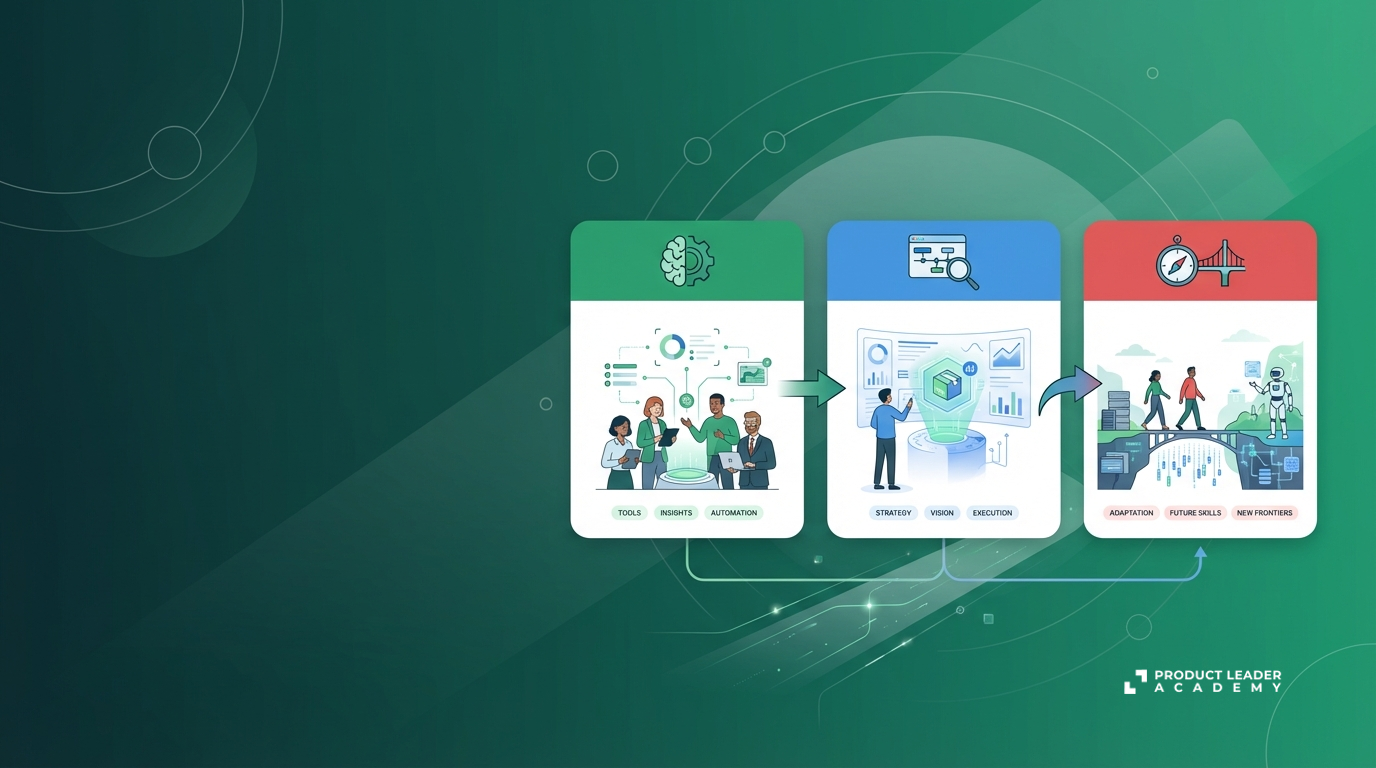
By 2026, the industry has split into two distinct, yet complementary, career paths. On one side, we have the AI-Powered PM—the evolution of the generalist who uses intelligence to 10x their personal and team output. On the other, we have the AI PM—the specialist architecting the complex, probabilistic engines that drive the products themselves.
Understanding which path you are on—and which one you want to be on—is the most critical strategic decision you will make for your career this decade.
Section 1: The Great Bifurcation of 2026
Why is 2026 the tipping point? Because we have officially moved from the era of "Experimental AI" to "Integrated AI."
In 2023, PMs were "playing" with ChatGPT to write emails or summarize meetings. By 2026, those capabilities are baked into the operating system of every enterprise. The "Generalist PM" of the early 2020s—the one who spent 60% of their time on coordination, documentation, and manual data analysis—is effectively extinct.
The role has diverged because the complexity of the tech stack has outpaced the ability of a single person to be both a high-level business strategist and a deep-tech model architect.
- The AI-Powered PM is the master of application. They use AI to bridge the gap between user needs and business value with unprecedented speed.
- The AI PM is the master of intelligence. They build the models, the data pipelines, and the agentic frameworks that the rest of the world consumes.
If you don't choose your path, the market will choose it for you.
Section 2: The AI-Powered PM – Efficiency as the New Baseline
The AI-Powered PM is the "Generalist 2.0." In this role, AI is not a feature you’re building; it’s the exoskeleton you wear to do your job. In 2026, being "good at your job" as a PM means you’ve automated the administrative burden of the role to focus entirely on strategy and empathy.
The Workflow Revolution
1. Automated Discovery Gone are the days of spending weeks conducting and transcribing 20 user interviews. The AI-Powered PM uses tools that ingest thousands of hours of sales calls, support tickets, and community forum posts in real-time. The AI doesn't just summarize; it identifies sentiment clusters. It tells you, "There is a 15% uptick in frustration regarding the checkout flow among users in the DACH region specifically when using mobile devices." Discovery is no longer a phase; it’s a continuous, automated pulse.
2. The "Living" PRD In 2026, a Product Requirements Document (PRD) is no longer a static Google Doc that goes to die in Confluence. It is a dynamic entity. As the engineering team updates the codebase, the AI-Powered PM’s documentation automatically updates to reflect technical constraints. If a PM changes a requirement, the AI flags the downstream impact on the API documentation and the go-to-market messaging.
3. Zero-Draft Culture The most significant shift is the end of the "blank page." AI-Powered PMs never start from scratch. Whether it’s a roadmap, a pitch deck, or a launch plan, the PM provides the intent, the constraints, and the data, and the AI provides the first 80%. The PM’s job has shifted from writing to editing and curating.
Success Metrics: Speed over Volume
For this role, the metrics have shifted. We no longer care about how many tickets were closed. We care about:
- Discovery Velocity: How quickly can we move from a customer "signal" to a validated hypothesis?
- Cycle Time: The duration from "intent" to "shipped value."
The Risk: The danger here is "Lazy Product Management." When AI makes it easy to generate plans, it’s easy to stop thinking from first principles. The AI-Powered PM who wins in 2026 is the one who uses the time saved to talk to more customers and think more deeply about long-term moats.
Section 3: The AI PM – Architecting Intelligence
While the AI-Powered PM uses tools, the AI PM builds the brain. This is a specialist role, often found in companies building LLMs, vertical AI agents, or complex predictive systems (e.g., autonomous logistics or personalized medicine).
The Technical Shift: From Logic to Probability
The fundamental difference in the AI PM’s life is the move from deterministic to probabilistic product management.
- Traditional PM: "If the user clicks X, then Y happens."
- AI PM: "If the user provides input X, there is an 88% probability the model will produce output Y, and we need a fallback for the other 12%."
The Data Moat
For the AI PM, the primary job isn't feature prioritization; it's data strategy. They spend their time asking:
- Do we have the right proprietary data to fine-tune this model?
- How do we handle "data poisoning" or drift?
- Is our RAG (Retrieval-Augmented Generation) pipeline retrieving the most contextually relevant information?
The New Squad
The AI PM doesn't just lead a team of Full-Stack Engineers. Their "squad" includes:
- ML Engineers: To optimize inference costs and model performance.
- Data Scientists: To validate the statistical significance of model outputs.
- AI Ethics/Safety Officers: To ensure the product doesn't hallucinate harmful advice or exhibit bias.
Success Metrics: The Technical Core
- Evals (Evaluation Frameworks): How accurately does the model perform against a gold-standard benchmark?
- Inference Cost: Can we provide this intelligence profitably at scale?
- Latency: Is the "thinking" time of the AI fast enough to maintain user engagement?
Section 4: Comparing the Toolkits – Skills for 2026
By 2026, "AI Literacy" is a prerequisite for both, but the execution depth differs significantly.
| Feature | AI-Powered PM (Generalist) | AI PM (Specialist) |
|---|---|---|
| Primary Goal | Maximize team output & user value. | Build and optimize the "intelligence engine." |
| Daily Tool | AI-integrated Jira, Miro, and GTM tools. | Vector databases, LLM Ops platforms, Weights & Biases. |
| Core Skill | Advanced Prompt Engineering & Workflows. | Fine-tuning, RAG strategy, & Model Selection. |
| Data Handling | Natural language to SQL for dashboarding. | Managing data pipelines and training sets. |
| Stakeholders | Marketing, Sales, Customers. | Research Scientists, ML Ops, Ethics Boards. |
The Overlap
Both roles must master Chain-of-Thought reasoning. This isn't just about "writing prompts"; it's about understanding how to break a complex business problem into a series of logical steps that an intelligence system (human or machine) can execute.
Section 5: UX & Strategy in the Age of Agents
By 2026, we have moved past the "Chatbot" phase. Users are tired of typing into boxes. We are now in the era of Agentic UX.
From "User Flow" to "User Intent"
In the past, PMs designed "flows"—a series of screens a user must navigate. In 2026, PMs design for "intent."
- Example: Instead of a travel PM designing a 10-step booking flow, they design a system where a user says, "Book me a trip to Tokyo that fits my budget and my love for brutalist architecture."
- The PM’s job is to ensure the Agent has the right permissions, the right data, and the right "guardrails" to take action on the user’s behalf.
Anticipatory Design
Both types of PMs must embrace products that "nudge." This is Anticipatory Design—using AI to predict what a user needs before they ask. If your product waits for a click in 2026, it’s already behind.
The Trust Gap
The biggest strategic challenge in 2026 is the Trust Gap. As products become more autonomous, users become more skeptical.
- The AI PM solves this through "Explainability"—building features that show why an AI made a certain decision.
- The AI-Powered PM solves this through "Transparency"—ensuring the GTM messaging and user interface clearly define where the AI ends and the human begins.
Section 6: Career Pathing – Which Way Should You Pivot?
The choice between these two paths isn't about which one pays more (though the AI PM currently commands a technical premium). It’s about where your passion lies.
The Decision Matrix
- Choose the AI-Powered PM path if: You love the "What." You are obsessed with market dynamics, user psychology, and business models. You want to use AI to build better products faster. You enjoy the "orchestration" of a product launch.
- Choose the AI PM path if: You love the "How." You are fascinated by how a machine learns. You enjoy the nuances of data architecture and the challenge of non-deterministic systems. You want to be at the frontier of what technology can actually do.
Future-Proofing Your Resume
To stay relevant in 2026, your resume needs to show more than "used ChatGPT."
- For the AI-Powered PM: Highlight Efficiency Gains. "Reduced discovery-to-delivery time by 40% using automated feedback loops."
- For the AI PM: Highlight Model Performance. "Improved RAG retrieval accuracy by 25%, reducing hallucination rates in production by 15%."
The Rise of Soft Skills
Ironically, as technical tasks become commoditized by AI, "Human Skills" have become more valuable. In 2026, the ability to negotiate with stakeholders, craft a compelling vision, and lead with empathy is the only thing AI can't replicate. The AI-Powered PM who can tell a story will always beat the one who just generates a report.
Section 7: Conclusion – Embracing the Augmented Future
The fear that "AI will replace PMs" was a 2023 anxiety. By 2026, we know the truth: PMs aren't being replaced by AI; they are being replaced by PMs who know how to build with and for AI.
The bifurcation into AI-Powered and AI PM roles is a sign of the profession's maturity. It allows us to specialize, to go deeper, and to solve more complex problems than ever before. Product Management in 2026 is no longer about "managing a backlog." It is about curating intelligence.
Your Action Plan for This Week:
- Audit Your Workflow: Identify one task you do every week that feels "robotic" (e.g., summarizing meeting notes, drafting tickets, or cleaning data).
- Experiment with "Powering": Find an AI tool or build a simple custom GPT to automate 80% of that task.
- Assess Your Interest: Do you find yourself more interested in the output of that automation, or are you curious about how the model arrived at the answer? That answer will tell you which path to follow.
The future of product leadership isn't about fighting the machine—it's about deciding which part of the machine you want to lead. Which path will you choose?